About
What do we do?
We are working to accelerate the transition towards a circular built environment, starting in Europe. As part of Circular Buildings Coalition (CBC), we bring together stakeholders from the built environment, support innovation, and the growth of markets for circular solutions, with the aim of encouraging a widespread adoption of sustainable practices.
Why does CBC exist?
The challenges of transitioning to a circular economy in the built environment are vast, with roots at local, national, and European levels. However, many impact-driven organizations worldwide are already addressing these challenges. As a coalition, we aim to amplify their efforts and lead the way forward.
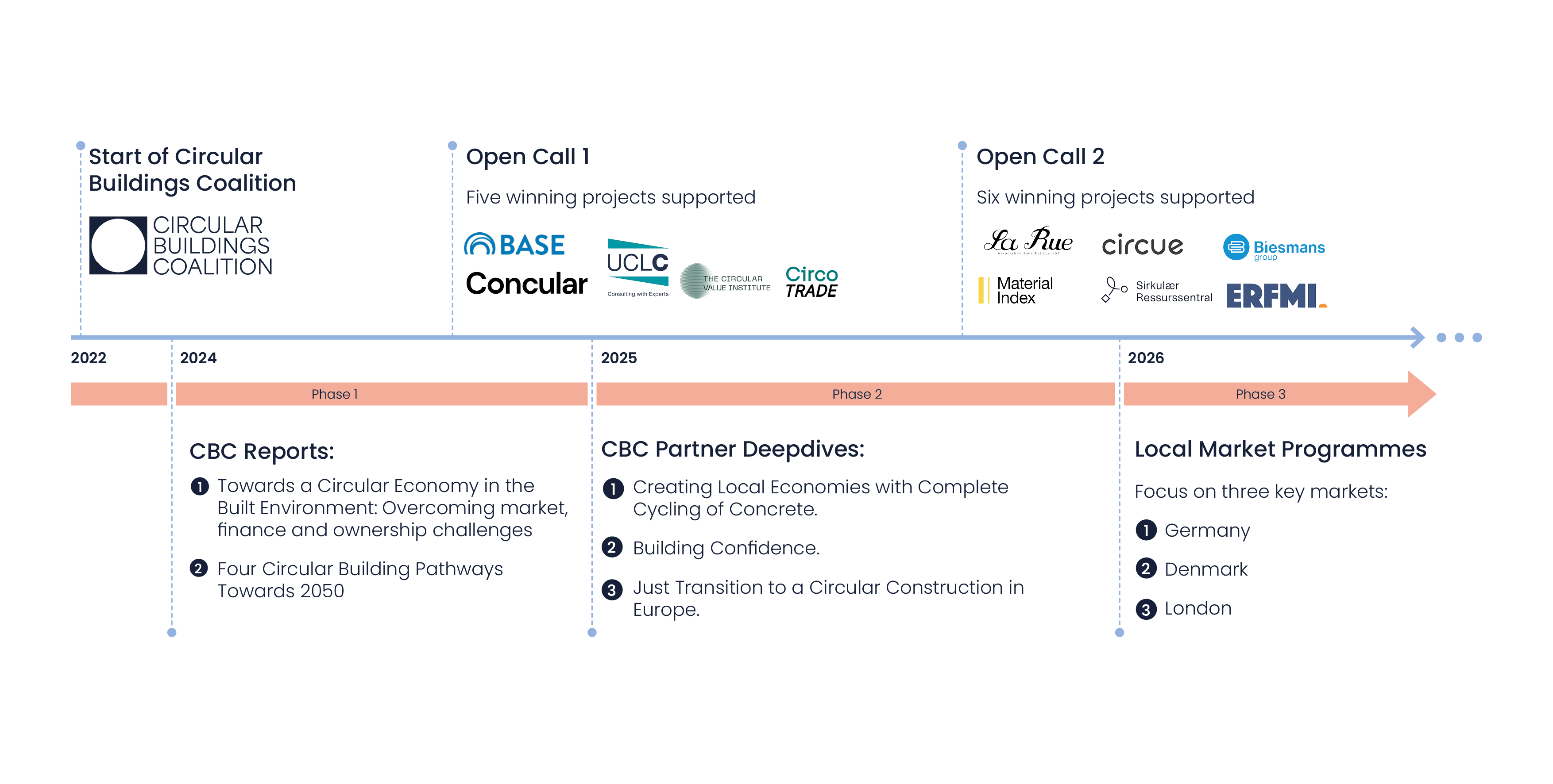
How do we move forward? CBC has a clear roadmap:
CBC's approach to creating systemic change has included the following:
- creating a common understanding across the value chain of the challenges and opportunities ahead;
- cultivating alliances and joining forces to formulate key ambitions;
- developing frameworks and policy;
- amplifying proven solutions.
Image

ARUP
ARUP
For over 75 years, Arup has been recognised for its vision, talent and tenacity. Dedicated to sustainable development, the firm is a collective of 16,000 designers, advisors and experts working across 140 countries. Founded to be both humane and excellent, we collaborate with our clients and partners using imagination, technology and rigour to shape a better world. By bringing together architecture, engineering and an ever-expanding roster of specialisms, our philosophy of Total Design has been at the heart of our most ambitious work.
Image

EEB
EEB
The EEB is the largest network of environmental citizens’ organisations in Europe. It currently consists of over 190 member organisations in 42 countries, representing some 30 million individual members and supporters.
EEB's mission is to be the environmental voice of its members and European citizens. It focuses on influencing EU policymaking and implementation, as well as conducting assessment of its agreed policies. It aims to be effective by combining knowledge with representativeness, active involvement of its members and coalition building.
The EEB’s circular economy team has strong experience in EU built environment policy and the ability to transform deep, technical project knowledge into actionable, high-level recommendations.
Image

Realdania
Realdania
Image

ReLondon
ReLondon
ReLondon is a partnership of the Mayor of London and the London boroughs to help London waste less and reuse, repair, share and recycle more. Established as a statutory Board under the Greater London Authority Act 2007 (as the London Waste and Recycling Board) to improve waste and resource management and transform the city into a leading low carbon circular economy, ReLondon delivers tailored support to government, businesses and citizens. Find out more: ReLondon
Image

Smith Innovation
Smith Innovation
Smith Innovation is the overall program manager for CBC, as well as being thought leaders when it comes to innovation in the construction industry.
Based in Copenhagen, we have experience with both Danish and international projects, working with philanthropic funds, systemic change at regional and municipality level, spearheading projects within strategic partnerships, and the landscape of new sustainable solutions in the built environment.
We view meeting climate requirements as an initial step towards systematically reducing the construction footprint across various aspects. The coalition is spearheading crucial efforts to promote the circular economy model and adhere to planetary boundaries. As we progress through this transition, it is crucial to ensure that present solutions are adaptable for a future characterised by limited resources. Embracing and implementing a circular economy ethos is a critical solution that must be fostered and integrated across sectors, particularly when considering the materials shaping our future buildings.
Image
World Green Building Council (WorldGBC)
World Green Building Council (WorldGBC)
The World Green Building Council (WorldGBC) catalyses the uptake of sustainable built environments for everyone, everywhere.
Transforming the building and construction sector across three strategic areas—climate action,health & wellbeing, and resources & circularity—we are a global action network of over 70Green Building Councils around the world.
As members of the UN Global Compact, we work with businesses, organisations andgovernments to drive the ambitions of the Paris Agreement and UN Global Goals forSustainable Development. Through a systems change approach, our network is leading theindustry towards a net zero carbon, healthy, equitable and resilient built environment.
CBC's Journey So Far...
CBC's approach to creating systemic change has included: creating a common understanding across the value chain of the challenges and opportunities ahead; cultivating alliances and joining forces to formulate key ambitions; developing frameworks and policy; as well as amplifying proven solutions.
This approach has been manifested in two key activity areas: firstly creating and sharing knowledge about the circular built environment and secondly providing support and funding to innovation through Open Calls for Blueprint Projects. CBC has provided support and funding in two rounds of Open Calls for Blueprint Projects (2024 & 2025), and continues to support local innovation through the current Local Market Programmes (2026).
These two key activities form a two-pronged approach of addressing change from a top-down and bottom-up approach, with the intention of both growing the solutions and developing the market for the circular built environment.
Current CBC partners are Arup, EEB, RealDania, ReLondon, Smith Innovation, UnternehmerTUM and World Green Building Council. Previous partners of CBC are: Circle Economy, Ellen MacArthur Foundation, Metabolic, and World Business Council for Sustainable Development (WBCSD).